Single user
€390
launch price until 30 Nov 2026 · then €490
- Full report, PDF
- Instant download after payment
- Download link also sent by email
Report · Edition 1.0 · October 2026 · 60 pages
Europe relies on others for most of its AI: the chips are designed in the United States and made in Taiwan and South Korea, most cloud capacity is American, and the most capable models come from the United States and China. This report examines what the European Union, its Member States and European organisations are doing about that dependence, and whether building on open-weight models is a realistic alternative to matching the most capable closed models. Its conclusion: open-weight models are a workable basis for European AI sovereignty, but not an escape from dependence. Europe can manage that dependence, but it cannot avoid it.
Summary, findings and chart free below. Full report from €390 (launch price), instant PDF download. No external funder.
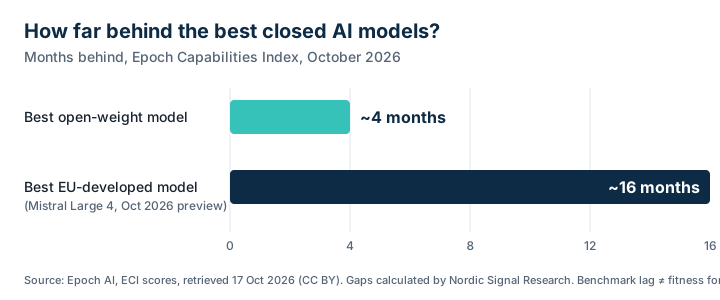
Open-weight models are about 4 months behind the best closed models; the best EU-developed model measured is about 16 months behind.
No independent test yet shows whether open models are good enough for European public services.
Europe allocates public computing at scale (about 55 million EuroHPC node-hours in 2025), but actual use is poorly reported.
Much of the programme is still to come: most of the 19 AI Factories are being set up, and AI Gigafactories won't run before 2028.
The strongest national assets are shared ones, such as LUMI-AI (six countries) and Alice Recoque (three).
The AI Act's high-risk rules are delayed to December 2027 and August 2028, and the relief for open-source models is narrow.
Licence terms matter as much as model quality; some licences withhold rights from EU-based companies.
The hardware will remain non-European for years: the EU makes about 10% of the world's semiconductors.
Customers now have a legal right to leave their cloud provider, but moving an AI system is still hard.
Make the Cloud and AI Development Act's sovereignty test evidence-based. Providers should demonstrate where services run, who can access data and keys, what falls outside their commitments, and how customers can leave.
Require regular usage reporting for EU-funded computing. Each EuroHPC facility should publish quarterly figures on time awarded, time used and waiting times.
Fund independent tests of open and closed models on public-sector work, through the Apply AI Strategy and the AI Office, with published methods and results.
60 pages: all findings, exhibits, the cost and delivery model, and about 110 dated references. Pay by card and download the PDF straight away.
€390
launch price until 30 Nov 2026 · then €490
Best value
€2,490/yr
per organisation
€1,490
one-off · whole organisation
Prices in EUR excl. VAT; applicable VAT is calculated at checkout. Payments are processed by Stripe as our reseller and merchant of record.
€2,490
one-off · organisation licence · Edition 1.0
Public sector licence, €990: order by email
Edition updates only: single user €390/yr, organisation €1,490/yr, public sector €990/yr: order by email